Why Personalized Learning Is the Future of Education
See how SISYA CLASS delivers personalized learning that outperforms traditional classroom methods.

Sisya Admin

Personalized Learning vs. Traditional Classrooms: Why SISYA CLASS Is Shaping the Future of Education
In an age where technology is transforming nearly every aspect of our lives, education too is undergoing a significant shift. One of the most important debates in modern education revolves around two distinct models: personalized learning and traditional classrooms. Each has its own philosophy, strengths, and challenges. Educators, parents, and policymakers are all asking the same question: Which approach is better suited to today’s students?
This blog explores both methods in depth, compares their effectiveness, and discusses how modern platforms are helping bridge the gap between the two. Finally, we’ll look at how a balanced and intelligent approach can lead to better academic outcomes and stronger future readiness for learners.
What is Personalized Learning?
Personalized learning is a student-centered approach that adapts the educational experience to fit the unique needs, interests, and pace of each learner. It recognizes that students do not learn in the same way or at the same speed.
This approach uses data, technology, and active teacher guidance to customize content and support, giving learners more control and responsibility in their education.
Key Principles of Personalized Learning
- Student-Centered Focus: Students actively shape their learning paths and take more responsibility for outcomes.
- Flexible Pacing: Learners move through content at their own speed, spending more time on areas where they need support and accelerating through concepts they’ve mastered.
- Customized Curriculum: Content is aligned with the student’s interests, learning style, and academic goals.
- Technology Integration: Adaptive learning tools, AI platforms, and data analytics are used to personalize instruction and provide immediate feedback.
- Skill-Oriented Learning: Emphasis on building independent learning skills, critical thinking, and real-world application.
Advantages of Personalized Learning
Personalized learning can significantly improve engagement and outcomes when implemented effectively. Key benefits include:
- Higher Engagement: Students are more invested when learning is relevant to their interests and goals.
- Improved Academic Performance: Learners progress based on mastery, which often leads to deeper understanding and better results.
- Accommodates Different Learning Styles: Instruction can be adapted for visual, auditory, or kinesthetic learners.
- Promotes Independent Learning: Students build self-discipline, motivation, and time management skills.
- Stronger Teacher-Student Relationships: Teachers act as mentors, guiding students through customized learning paths.
Challenges of Personalized Learning
Despite its advantages, personalized learning also presents several challenges:
- Time-Intensive for Teachers: Creating and managing individual learning paths requires significant effort and planning.
- Assessment Difficulties: Measuring progress uniformly across personalized paths can be complex.
- Technology Access: Limited access to digital devices and the internet may affect equity.
- Data Privacy Concerns: Collecting student data for personalization must be done responsibly.
- Reduced Group Interaction (in some models): Over-personalization can lead to decreased collaboration among peers if not balanced well.
What is the Traditional Classroom Model?
Traditional classrooms have been the cornerstone of education for decades. In this model, a teacher leads a group of students through a standard curriculum, following a fixed schedule and assessment cycle.
This structure is familiar and trusted by educators and families alike, providing a uniform experience for learners across a school or system.
Key Principles of Traditional Classrooms
- Teacher-Led Instruction: The teacher delivers the content and manages the learning process.
- Standardized Curriculum and Pacing: All students are taught the same material at the same time.
- Fixed Schedules: Classes follow a daily or weekly timetable with pre-defined lesson plans.
- Group-Based Learning: Emphasis on classroom interaction and collaborative learning.
- Physical Learning Environment: In-person instruction in a structured school setting.
Advantages of Traditional Classrooms
Traditional classrooms continue to offer important educational benefits, especially in structured and social environments:
- Structured Routine: Helps students develop time management and organizational habits.
- Social Skill Development: Encourages collaboration, communication, and group learning.
- Immediate Clarification: Teachers can address student doubts and behavior in real-time.
- Access to Campus Resources: Includes labs, libraries, sports facilities, and extracurricular programs.
- Proven Framework: A long-established system with clearly defined academic benchmarks.
Challenges of Traditional Classrooms
Despite being widely accepted, the traditional model has certain limitations:
- One-Size-Fits-All Approach: May not address the varying abilities and needs of individual students.
- Limited Individual Attention: Teachers may not be able to cater to every student in large classrooms.
- Passive Learning: Often lecture-based, which can reduce student participation.
- Overemphasis on Exams: Focus on test scores can overshadow creativity and conceptual understanding.
- Resistance to Technology Integration: Many traditional classrooms are slow to adopt digital tools.
Personalized Learning vs Traditional Classrooms: A Comparison
Understanding how the two models differ can help stakeholders make informed decisions.
| Criteria | Personalized Learning | Traditional Classrooms |
| Learning Pace | Flexible and student-driven | Fixed and uniform |
| Curriculum | Customized for individual needs | Standardized for all |
| Technology Use | Core to content delivery | Supplementary or minimal use |
| Student Role | Active participant and decision-maker | Passive recipient of instruction |
| Teacher Role | Mentor and facilitator | Instructor and authority figure |
| Assessment Style | Based on mastery and growth | Based on standardized tests |
| Social Interaction | Can vary depending on model | Built-in through daily group activities |
The Ideal Solution: A Blended Learning Model
Many experts agree that the future of education lies not in choosing one model over the other, but in blending the strengths of both.
A blended learning model combines the personalization and flexibility of digital tools with the structure and social interaction of the classroom.
This approach allows students to access customized support and still participate in collaborative, hands-on learning experiences.
Bridging the Gap with SISYA CLASS
As the need for hybrid learning grows, some educational platforms are leading the way by combining personalized education with structured support. SISYA CLASS is one such platform, offering a balanced and intelligent solution for students from Classes 1 to 10.
How SISYA CLASS Supports Personalized Learning
SISYA CLASS is the best online learning platform in India. SISYA CLASS is designed to meet the learning needs of today’s students using a combination of AI-powered technology, live mentor support, and curriculum-aligned content.
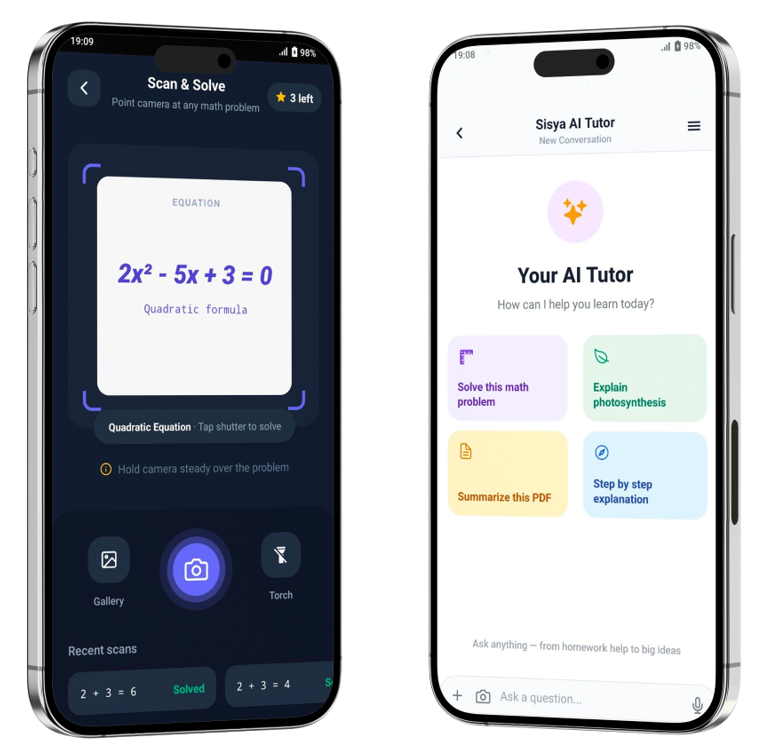
Students can ask questions anytime—through text, voice, or even an image through AI-powered learning for school students. The platform uses real-time AI to deliver instant, accurate answers based on the student’s syllabus and grade level.
Key Features of SISYA CLASS
- 24x7 AI Doubt Solving: Instant support for students across text, voice, or image inputs.
- Curriculum Alignment: Covers CBSE, ICSE, and State Board syllabi for all major subjects.
- Expert Faculty: Courses are led by experienced educators from IIT and NIT backgrounds.
- Live Mentor Support: Weekly live sessions provide real-time clarification and guidance.
- Interactive Learning Tools: Includes worksheets, assessments, class notes, and revision material.
- Skill Development Opportunities: Offers learning in coding, robotics, and logical reasoning.
- Monthly Tech Fests and Hackathons: Encourage innovation and creativity through real-world application and peer competition.
The platform is available online, making it accessible to students across different locations. It offers a user-friendly interface and is the only live doubt-solving EdTech in India. Designed for CBSE/ICSE personalized tutoring, it includes an annual all-subject plan that combines academic excellence with essential future-ready skills
Conclusion
Both personalized learning and traditional classrooms offer valuable learning experiences. While one provides flexibility, adaptability, and individual focus, the other delivers structure, discipline, and social development.
The most effective educational environment for modern learners may be one that blends both approaches thoughtfully.
By integrating the strengths of these models, platforms like SISYA CLASS are helping students build a solid academic foundation while also preparing them for the future.
Whether your child needs better exam performance, support in complex subjects, or an opportunity to explore new technologies like coding and robotics, SISYA CLASS is designed to support their complete educational journey.
Frequently Asked Questions (FAQs)
1. What is SISYA CLASS?
SISYA CLASS is an online learning platform for Classes 1 to 10, offering personalized, curriculum-based education with AI-powered doubt solving.
2. How does SISYA CLASS solve student doubts?
Students can ask doubts via text, voice, or image, and get instant answers from SISYA’s 24x7 AI chatbot.
3. Which boards does SISYA CLASS support?
The courses are aligned with CBSE, ICSE, and major State Boards, ensuring relevance for all school students.
4. What subjects are covered in SISYA CLASS?
Subjects include Maths, Science, English, Coding, Robotics, and more, taught by IIT/NIT experts.
5. Are there live classes or just recorded lessons?
SISYA offers both live mentor sessions and self-paced learning through recorded content and AI support.